How to get an e-commerce license in Dubai in 2026: 12 steps for a fast, compliant launch
How to get an e-commerce license in Dubai in 2026: 12 steps for a fast, compliant launch
Your end-to-end roadmap for setting up and scaling an online store in the UAE—without costly rejections or delays.
Vincy Amirtharaj
58 post
Senior Business Setup Consultant, Dubai
The UAE’s e-commerce market is projected to surpass AED 50.6 billion by 2029, according to a report released by EZDubai, pushing everyone from Amazon.ae sellers to Instagram boutiques to open an official business. If you are wondering how to secure an e-commerce licence in Dubai in 2025, we have got you covered. This guide will walk you through the exact steps, costs and paperwork you’ll need to turn your side hustle to a fully licenced online store trade licence Dubai holder.
The process is now far smoother with the 2025 reforms, whether you go for a DET e-Trader licence on the mainland, an IFZA free-zone e-commerce package or the duty-free Dubai CommerCity setup. UAE Pass digital signatures, Cross-Border E-Commerce and the updated “Digital Commerce” activity code now allow most straightforward applications to get approved within weeks. You can budget with clarity by following the details of the real world e-commerce licence cost Dubai 2025 benchmarks.
You will also learn how to obtain a payment gateway Merchant ID, start a UAE corporate bank account, set up COD couriers and maintain compliance with data privacy and PCI-DSS requirements. This step-by-step guide to open an online store in UAE, will further help you avoid the three common pitfalls that hold back first-time applicants which include choosing the wrong activity code, overlooking a refund policy and facing delays in gateway KYC.
Typical 6-week licence-grant timeline
Week
Authority / Task
Key output
1
DET or Free Zone
Initial approval ✓ | Trade-name cert ✓
2
DED / Free Zone
E-commerce licence issued ✓
3
Federal Tax Authority
VAT TRN issued
4
Bank
Corporate account opened
5
Payment-gateway
Merchant ID (MID) live
6
Courier / 3PL
Fulfilment contract & API keys – Go live!
Note: IFZA & SHAMS fast-track bundles can compress Weeks 1-2 to
48 hours; bank KYC may extend Week 4 if shareholders reside abroad.
“By integrating services from multiple authorities, embedding AI into core processes, and offering omni-channel support, we are making it simpler, faster, and more cost-effective to do business in Dubai. This is giving entrepreneurs, SMEs, startups, and global corporations alike the confidence to invest and expand in Dubai with absolute clarity.” - Salwa Al Adidi, Director of Data Management at DBLC
Follow this 12-step checklist to complete your
e-commerce-licence process in Dubai.
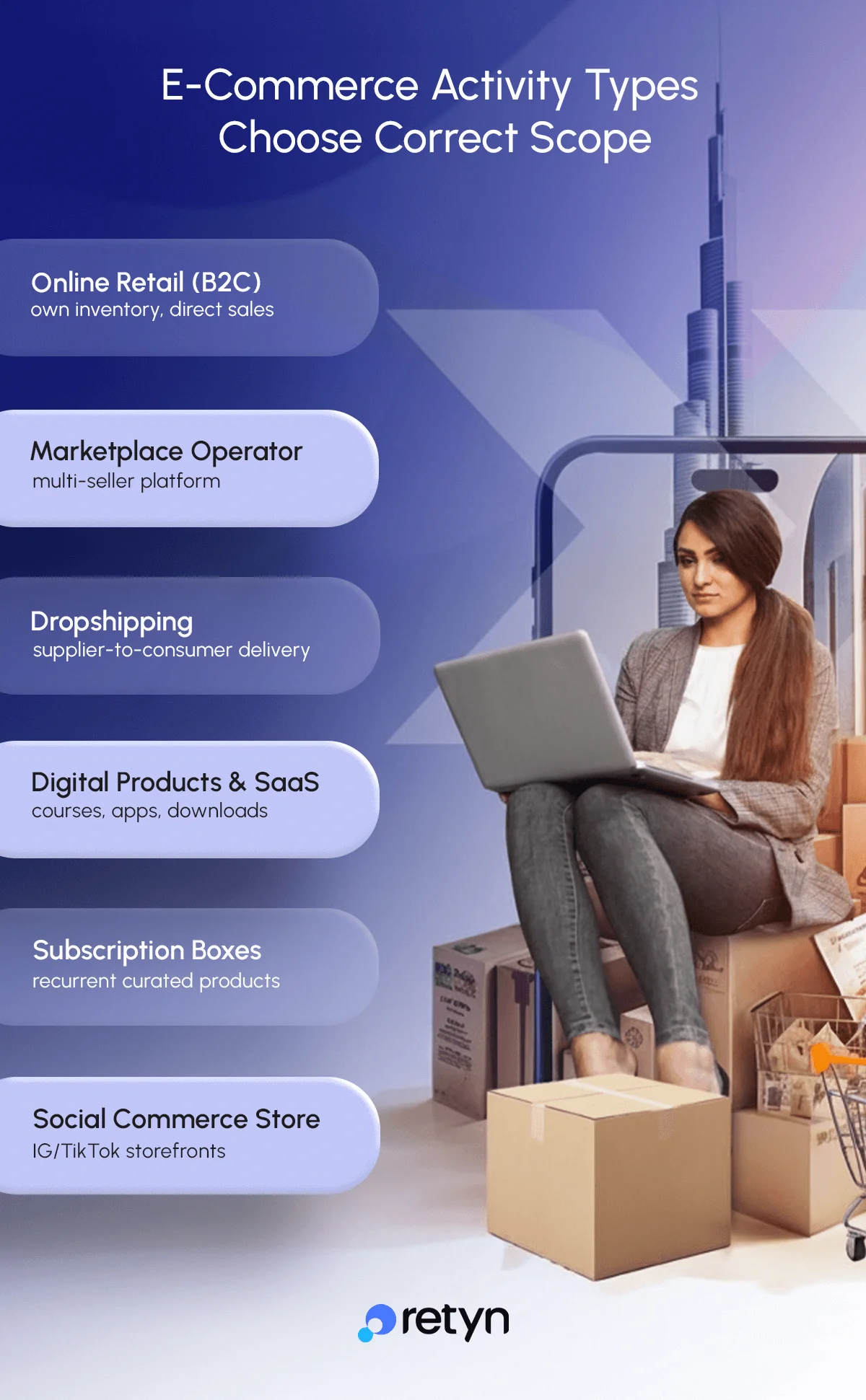
Step 1: Define your e-commerce activity scope
Match your planned online activities to the official licence categories:
This is the first and most important step in any ecommerce business setup in Dubai because choosing the correct activity determines what you’re legally allowed to sell and which permissions you’ll need later.
Online retail (B2C)
Own-inventory webstore selling physical goods.
Marketplace operator
Multi-vendor platform charging listing or commission fees.
Dropshipping
Supplier‐to-consumer fulfilment; no warehousing in UAE.
Influencer storefronts on Instagram / TikTok Shop.
Pro tip
Start with one core activity code (e.g., “Online store”)—adding codes later is cheaper than deleting unused ones at renewal.
Step 2: Reserve a trade name
Pick a brandable, e-commerce-friendly name (avoid “bank”, “media”, “government”) and reserve it via DET e-Services or your free-zone portal. Secure the matching .com or .ae domain—banks often reject generic Gmail addresses.
During your business setup in Dubai, regulators check that your name aligns with your activity and does not include restricted terms.
Change - Sell to UAE consumers directly
Quick Fact
Since its debut in 2021, the Invest in Dubai platform has enabled the incorporation of 280,916 new businesses.
Shopify/Magento stack, PCI-DSS gateway, privacy & cookies policy.
Pro tip
The Modern Technology-Based Trade Law requires online sellers to display all prices, fees, logistics terms, digital contract terms, and consumer rights clearly before purchase.
Payment-gateway security deposit: from AED 2 500 (refundable)
*The AED 10 000 e-commerce bank guarantee was abolished in 2024.
Licence-cost estimator (AED)
Estimated setup cost: —
Get detailed breakdown on WhatsApp
Includes AED 740 for initial approval (120) + trade-name reservation (620).
Hosting, marketing, and gateway fees vary—contact us for an exact quote.
Step 4: Select the right business structure
Your structure affects VAT, payment-gateway approval, and investor visas:
LLC (Mainland)
Own online store with local delivery; strong bank credibility.
Sole establishment
Low-cost option for influencers or freelancers; personal liability.
Free-zone FZ-LLC / FZE
100 % foreign ownership; licence issued by zone authority.
Branch office
Let an overseas brand trade locally under its parent balance sheet.
Pro tip
VAT registration is mandatory once taxable supplies and imports exceeds AED 375,000 in any rolling 12-month period. 9% CT is applicable on taxable income above AED 375,000.
Understand your E-commerce setup options
Explore cost calculators, licensing pathways, and the support services available to help you launch with confidence.
Full e-commerce ecosystem: warehousing, duty-free hub, DDP couriers.
Quick Fact
The UAE e-commerce sector is forecast to reach USD 20.54 By 2030
Source: Mordor Intelligence
Step 6: Apply and obtain your e-commerce licence
Complete the online forms, upload documents, and apply for the VAT registration.
Mainland
DET commercial license
Select “Online Seller” activity. (Code 6312009).
Professional indemnity (optional)
Cover cyber-fraud or mis-sale claims (AED 250 k+).
VAT TRN
register if the AED 375,000 revenue threshold is met.
Free zone
Online application
IFZA / Meydan portal — 24-48 h.
Legal form
FZ-LLC (multi-shareholder) or FZE (single owner).
Activity code
“Select the relevant activities. Activity names vary according to free zone authority”.
Virtual / flexi desk lease
Accepted for low-inventory models.
Licence-application document checklist
Mainland LLC / Sole Establishment
Passport + UAE entry stamp (all shareholders)
Emirates ID or UID number
Ejari lease or shared-desk contract
Draft privacy & refund policy
Initial approval & trade-name certs
Free Zone (e.g. IFZA, Meydan)
Passport copy (all shareholders)
Recent photo + CV (free-zone rule)
Virtual office / flexi-desk agreement
Supplier contracts or invoices
Payment-gateway intent letter
Proof of address (utility bill)
Tip: Upload PDFs at 300 dpi; max file size 10 MB per the “Invest in Dubai” portal.
sequenceDiagram
participant Founder
participant DED as DED / Free Zone
participant FTA as Federal Tax Authority
participant Bank
participant Gateway as Payment Gateway
Founder->>DED: 1 · Initial approval & trade name
DED-->>Founder: Certificates
DED-->>FTA: Register for VAT
FTA-->>Founder: TRN issued
Founder->>Bank: 2 · Account opening
Bank-->>Founder: IBAN active
Founder->>Gateway: 3 · MID application
Gateway-->>Founder: Merchant ID live
Step 7: Register immigration files & staff visas
Create the GDRFA establishment card, enrol in WPS payroll, and issue investor/employee visas. Delivery riders need RTA ID if you run own fleet.
Pro tip
New 5-year Green Visas for founders. Upon incorporation or contribution, the investor's or partner's share cannot be less than one million paid Dirhams.
If you're unfamiliar with UAE immigration procedures, working with visa processing services in Dubai can simplify the application step.
Step 8: Open a corporate bank account
Provide your licence, VAT TRN, supplier invoices, and AML policy. A live website with SSL and domain email speeds up KYC.
TDRA provides an NOC for activity of an economic nature on the internet.
UAE Pass verification
Mandatory for all shareholders since Q3-2025.
Selling food, cosmetics, or supplements? Register each SKU with Dubai Municipality’s Montaji portal before import.
Step 10: Arrange insurance & safeguards
Maintain cyber liability, product liability, and staff medical cover. Cargo insurance needed if you stock inventory in UAE.
Cyber liability
Data-breach & ransomware cover (AED 500 k+).
Product liability
Mandatory for cosmetics / electronics sellers.
Professional indemnity
Covers misleading descriptions / advice.
Expert insight: Macro shifts every e-commerce founder should track
The three most impactful factors that will shape how Dubai retailers use their digital retail strategy between 2025-2028 are becoming increasingly clear. These include the increase in the GCC duty-free threshold, the implementation of Strong Customer Authentication (SCA) across all of Dubai and the rapid expansion of areas in which a retailer can offer 15-minute deliveries through micro-fulfilment centres. Those entrepreneurs who have the opportunity to move ahead of this curve stand to benefit. By streamlining cross-border product movement with lower tax costs, by improving their customer checkout experience and by securing long-term dark store leases for their last mile logistics entrepreneurs will gain the first-mover advantage. They will then be able to capture significant market share before their competitors are able to respond.
Below we have listed three key strategic levers that go far beyond discount codes or ad budgets. Each of these can boost the potential to raise profit per order in a market landscape where fast delivery and seamless payments now outperform prices alone.
Cross-border e-commerce from Dubai
Dubai has evolved into a global cross-border e-commerce hub supported by its advanced logistics ecosystem, free-zone benefits and policies that enable merchants to reach customers throughout the Middle East, Asia, Africa and Europe. With digital boundaries diminishing, brand owners are able to tap into global demand from Dubai with less friction than traditional export channels typically involve.
Smart e-commerce entrepreneurs take advantage of this trend by using Dubai's free zone for tax-efficient company formation, tapping into its state-of-the-art air, sea and land freight networks (such as Al Maktoum Airport and Jebel Ali Port). They also adopt multi-currency payment gateways with localized checkout flows. These enablers support seamless global sales, faster fulfillment and effortless expansion of market reach beyond the UAE.
Advanced authentication methods
UAE's central bank has introduced a new policy that bans traditional one-time passwords (OTPs) from being used for online transactions. The policy requires financial institutions to implement advanced user authentication options. These include Emirates Face Recognition, as well as other forms of biometric verification and mobile-based soft tokens.
A number of major financial institutions in the region are already implementing biometric and in-app solutions for the majority of online banking services. Examples of these include Emirates NBD, FAB and ADIB.
15-minute delivery micro-hubs
Micro-hub zoning permits are now allowed within residential neighborhoods. Meanwhile average daily orders for dark stores are growing by more than 40% each month.
Commercial-scale autonomous-robot delivery is currently operational at Yango Group and noon, both of whom are utilizing neighborhood-scale robot fleets to lower the cost of last-mile labor and enable completely contactless 15-minute delivery. Early adopters are leveraging this business model to build customer loyalty prior to their competitors being able to respond.
Pro tip
Add a “duty-optimised shipping” badge and
biometric-checkout logo to product pages—tests show a
4-6 % boost in conversion when customers see cost & security
advantages upfront.
Step 11: Stay compliant — renewals & taxes
Log these annual / quarterly tasks to avoid fines:
Licence renewal
DET / free-zone every 12 months.
VAT returns
Quarterly if taxable turnover ≥ AED 375 k.
Corporate Tax & ESR
9 % CT filing + Economic Substance Report.
PCI-DSS scan
Annual SAQ A or quarterly ASV scan for card data.
Gateway re-KYC
Payment processors run KYC every 12–18 months.
Pro tip
Create a shared compliance calendar for licence, VAT, PCI scans, and CT deadlines—bank auditors often ask for evidence of tracking.
Publish a UAE PDPL requirements privacy-policy page, enable SSL/TLS, and complete a PCI-DSS Self-Assessment Questionnaire (SAQ A) if you use hosted payment pages.
Privacy policy
Must list cookies, data retention, and DPO email.
Cookie banner
Obtain user consent before non-essential cookies.
PCI-DSS SAQ A
Self-assessment and quarterly vulnerability scans.
Pro tip
Add a security-seal badge (McAfee / Sectigo) to checkout. It can improve trust perception.
Risk & penalty matrix – key non-compliance fines
Offence
Fine (AED)
Fix-time / sanctions
Trading online with an expired licence
5000
30-day grace then site block
Collecting payments without PCI compliance
Up to 100 000
Gateway suspension until SAQ passed
Failing to file VAT return on time
1 000 first offence, 2 000 repeat
Additional 4 % per month interest
Always verify latest circulars.
Selecting an activity code that excludes COD—couriers will refuse pickup.
Launching the site without SSL—payment gateways will block integration.
Ignoring cookie-consent—Digital Dubai has started random audits.
Under-budgeting cyber insurance.
Using a generic Gmail—banks prefer @brand.com emails.
Regulation & News updates · 2025
UAE launches first CBDC payment, unveiling new payment innovations - 19 Oct 2025:
UAE executes first CBDC transaction via the new Jisr platform; instant-payment systems expanded and Jaywan multi-scheme card introduced.
Dubai Customs begins transition to new 12-digit tariff code - 25 Jul 2025:
Dubai Customs has begun the phased rollout of the new 12-digit HS tariff codes, current 8-digit codes continue during the transition period.
UAE urges companies to prepare early for 2026 e-invoicing rollout - 28 May 2025:
E-invoicing launches in 2026 and businesses are advised to get their systems, data and invoicing processes in advance.
ADGM proposes new retail consumer protection rules - 15 May 2025:
ADGM plans new rules for retail and online sellers covering product labelling, promotions, warranties and complaint handling.
UAE launches Jaywan, its first national payment card scheme - 27 Feb 2025:
Jaywan is now active nationwide, with cards usable for in-store, online and ATM transactions, both locally and internationally.
ADGM cuts commercial licence fees for non-financial and retail businesses - 02 Jan 2025:
ADGM reduces registration and renewal fees 50% or more, with major cuts for non-financial and retail licences.
Glossary of acronyms
TRN – Tax Registration Number
MID – Merchant ID (payment gateway)
PCI-DSS – Payment Card Industry Data Security Standard
SSL/TLS – Secure Sockets Layer
COD – Cash on Delivery
CT – Corporate Tax (9 %)
FAQs on securing an e-commerce licence in Dubai
IFZA and SHAMS clean applications are issued within 48-72 hours. DED Mainland e-trader or portal licences may take around 10-15 working days after your UAE Pass verification, trade-name certification and lease are uploaded.
No. The UAE removed the local sponsor requirement under the Companies Law enacted in 2021. As a result, both mainland and free-zone e-commerce activities allow 100% foreign ownership.
You must register for VAT once your taxable turnover is expected to exceed AED 375,000 in any rolling twelve-month period. During your licence application, you may choose to pre-register for VAT, which will automatically generate your TRN in the FTA portal.
Trade-licence PDF and VAT TRN
Live website with SSL, privacy policy and refund policy
Corporate bank-account letter (IBAN)
Passport and Emirates ID for all shareholders
Projected 12-month sales volume
Both Stripe and Telr usually approve your application within 3-5 working days after receiving all completed documentation..
Yes. If you have an IFZA or SHAMS free zone licence, you can do pure drop shipping from a virtual office or flexi desk space. You must declare your international supplier in your business plan and include invoices with every shipment to prevent customs delays.
The renewal fees include:
Mainland LLC (DED + Ejari): Average annual renewal costs range from AED 7,000 to AED 10,000.
IFZA/SHAMS (Flexi-desk licence): Average annual renewal costs range from AED 9,000 to AED 12,000.
Once your taxable profit exceeds AED 375,000, you are required to pay 9% corporate tax. However there is currently a tax exemption for cross-border drop shipped products that are shipped directly to consumers outside the UAE.
Disclaimer: This content is for information only and not legal advice. Regulations change — always consult a qualified professional.
Need help getting your e-commerce licence approved?
Book a free consultation with our team for step-by-step guidance.